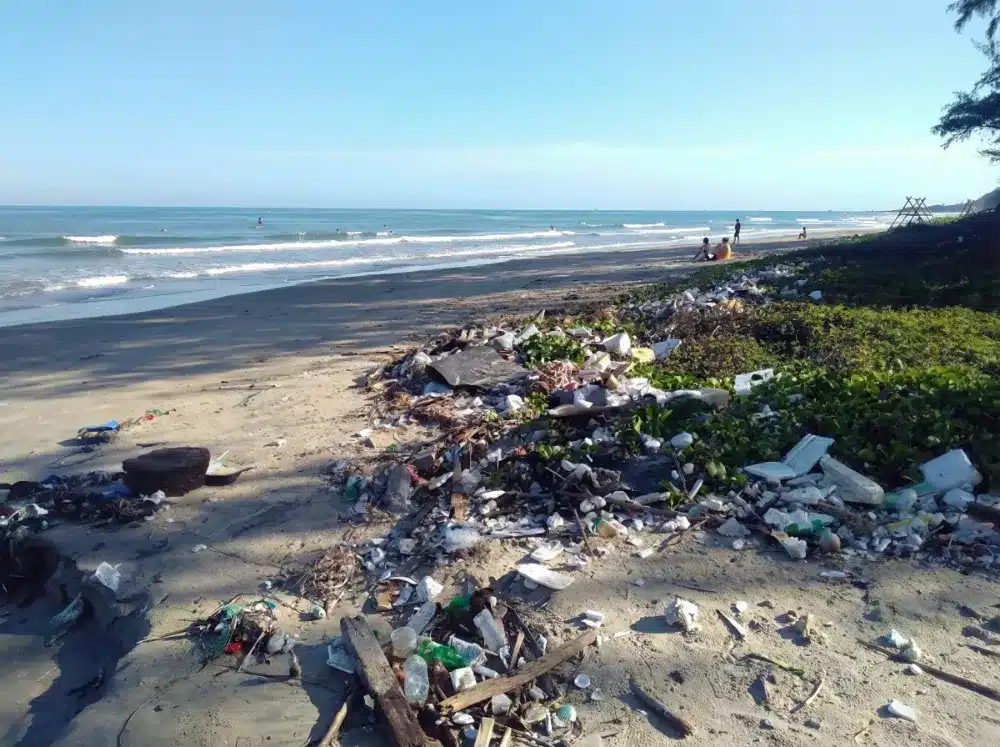
Plastic is undoubtedly one of the main causes of marine pollution. Among all types of environmental waste worldwide, plastic waste stands out as especially harmful. It accounts for more than 50% of total marine litter, making it a major threat to ocean health and ecological balance.
Every year, hundreds of millions of tons of plastic waste enter the ocean through rivers, coastal discharge, wind, and ocean currents. Plastic fragments, bags, cutlery, fishing nets and other items do not easily break down. They float on the sea surface or sink to the seabed, causing long-term damage to marine life, fishery resources, and even human health.
In October last year, the United Nations Environment Programme (UNEP) released its latest authoritative report, From Pollution to Solution: A Global Assessment of Marine Litter and Plastic Pollution. This globally significant report presents detailed data showing the seriousness of the situation. It estimates that there are currently between 75 million and 199 million tons of plastic waste in the world’s oceans. These non-degradable pollutants make up about 85% of all marine litter by weight, making plastic the dominant source of ocean pollution.
Even more concerning is the future outlook. If countries around the world do not take strong and systematic action — including reducing plastic production, banning unnecessary plastic use, and promoting alternative materials — the situation will worsen. According to professional modelling, by 2040 the amount of plastic entering aquatic ecosystems each year could nearly triple, reaching between 23 and 37 million tons annually. This would place devastating pressure on oceans, rivers, wetlands and other ecosystems.
This article takes a look at five major new plant base eco packaging materials: pineapple leaves, coffee grounds, peanut shells, apple pomace, and banana leaves. Let’s see how much you know about them.
01 Pineapple Leaf Packaging Material / Pineapple Leaf Fiber
The Designer’s Eco-friendly Packaging Design
Designed to interact with the user, this packaging aims to provide a deeper understanding of seeds and plants rather than being discarded! The plantable characteristic of the design ensures that its life does not end immediately after consumption. Its utility constantly changes before, during, and after use—this is the idea of combining a circular economy with sustainable design. Every seed is strictly selected, and these seeds can be seamlessly embedded into the material.
Outer Packaging Made of Waste Pineapple Leaves
The outer packaging is a special paper made from waste pineapple leaves. This is the result of an initiative launched by the Design Center of the Philippines, aiming to promote local communities and resources, especially since the Philippines is one of the world’s largest pineapple producers. The design helps eliminate unnecessary waste and encourages local people to actively contribute to the protection of Philippine flora.
Technical Profile:Pineapple Fiber
Pineapple fiber, namely pineapple leaf fiber, also known as pineapple hemp, is a fiber extracted from pineapple leaves and belongs to the leaf-derived bast fiber category. Pineapple fiber is composed of many closely combined fiber bundles, and each fiber bundle is made up of a collection of 10 to 20 single fiber cells.
Surface: The fiber surface is rough with longitudinal slits and holes; horizontally, there are nodes and no natural twist. Cell Structure: Single fiber cells are cylindrical with pointed ends and a smooth surface with a linear central cavity.
Appearance & Texture: Pineapple fiber has a white appearance and is soft and smooth. It feels like silk, which is why it is also called “Pineapple Silk.”
Processing & Use: After deep processing, pineapple fiber is white, soft, and smooth. It can be blended with natural or synthetic fibers. The produced fabrics are easy to dye, breathable and sweat-absorbent, crisp and wrinkle-resistant, and comfortable to wear.
A German design studio has pioneered a range of eco-conscious drinkware, with their latest innovation featuring a reusable takeaway cup crafted from spent coffee grounds.
Out of 100 grams of ground coffee, only about 30% is extracted into the beverage, leaving the remaining 70% as waste. Annually, approximately 6 million tons of coffee grounds are discarded due to a lack of recycling infrastructure, posing a significant environmental burden. Furthermore, the International Coffee Organization reports that 600 billion paper and plastic cups are consumed and discarded globally each year—a critical sustainability challenge.
Driven by the vision of transforming waste into value, the designer spent three years experimenting to develop a proprietary bio-material: Kaffeeform.
To create this material, spent grounds are collected from local Berlin cafes, dried, and compounded with biopolymers, starch, cellulose, wood, natural resins, waxes, and oils. The resulting composite is biodegradable, lightweight, and retains a subtle coffee aroma with a sophisticated dark-wood aesthetic. Following the 2015 launch of their signature Espresso cup, the company introduced a Cappuccino edition in 2016.
In 2018, the lineup expanded with the Weducer cup, designed as a durable alternative to single-use paper cups. While these products are engineered for longevity and end-of-life biodegradability, Kaffeeform has introduced a closed-loop service: recovering used cups to transform them into 3D printing filaments. These filaments are then used to manufacture architectural tiles or new vessels, epitomizing the principles of a circular economy.
As a sustainable resource, coffee grounds significantly enhance recyclability while drastically lowering carbon footprints. Compared to equivalent materials, its carbon emissions are 48% lower than bamboo charcoal and 85% lower than coconut charcoal. Its ability to decompose naturally ensures zero post-consumer pollution. For the future of sustainable fashion and lifestyle design, coffee grounds represent a high-potential material that warrants deeper exploration.
03 Peanut Husk Seed Packaging
This spoon, crafted from peanut husks, serves as an innovative seed package. Designed to house a single seed, the peanut husk spoon is used to plant the seed at the optimal depth. Ultimately, the user can crush the spoon and leave it in the soil, transforming the packaging into a natural fertilizer that provides essential nutrients for the growing seed.
The most impactful packaging innovations harmonize creative design with sustainability and a superior user experience. By integrating a seed-sized indentation to nestle the seed and adding measurement markings to the spoon, users can easily gauge the correct planting depth while facilitating the breaking of the material. Furthermore, infusing the husk with growth-promoting nutrients during the manufacturing process ensures higher germination rates—a feature that significantly enhances consumer appeal.
The entire process is profoundly poetic; the packaging serves a distinct purpose at every stage of its lifecycle, generating zero waste. This approach is inherently eco-friendly and sustainable, ensuring a truly circular journey from package to plant.
04 Apple Pomace
According to Oregon State University, Professor Yanyun Zhao and her research team are making critical breakthroughs in developing eco-friendly packaging materials using apple pomace as the primary raw material. This innovation is poised to become a sustainable alternative to widely used plastic packaging.
“Currently, apple pomace is typically composted or used as animal feed,” states the research, which aims to reduce food loss and waste across the entire supply chain. “We thought, why not transform it into an eco-friendly product that meets industrial demands?” The team is utilizing apple pomace as the core component for molded pulp packaging products, such as takeaway containers, flowerpots, beverage cartons, bottles, and clamshell packaging for fresh produce. Apple pomace was chosen partly due to its high availability in the Pacific Northwest; when apples are processed for juice, approximately 25-30% of the fruit remains as pomace.
The scope of this new material extends beyond apple pomace to include residues from other fruits and vegetables, as well as grape pomace from wine production. Traditionally, molded pulp products like food trays and beverage containers have relied on recycled newspapers as their primary feedstock, valued for their biodegradability. However, as the supply of recycled newspaper declines annually, scientists are actively seeking alternative raw materials—leading to the strategic upcycling of apple pomace. Professor Zhao’s team has already secured patents for the manufacturing processes of this apple pomace-based packaging.
05 Banana Leaf Packaging
As one of nature’s most inherent biodegradable materials, leaves—such as banana or pandan leaves—are traditionally used in Thailand to wrap desserts. The vibrant green hue not only enhances the visual appeal of the food but also infuses it with a subtle, natural fragrance.
Banana fiber is derived from the pseudo-stems of banana plants and is primarily composed of cellulose, hemicellulose, and lignin. Once chemically degummed, these fibers can be utilized in cotton spinning. Through a combined treatment process of biological enzymes and chemical oxidation—followed by drying, scouring, and defibrating—the resulting fiber is lightweight, lustrous, highly absorbent, and possesses strong antibacterial properties. It is fully biodegradable and environmentally friendly.
Japan leads the global research into banana fiber, while Southeast Asian nations like India, which possess abundant banana resources, have also conducted extensive studies. Significant progress in fiber extraction and product development is also being made in China. The successful production of banana fiber greatly expands the industrial utility of banana stems while mitigating the global shortage of natural fibers.
Dedicated to providing customers with one-stop solutions, from creative design to meticulous production and secure delivery, ensuring perfection at every step.