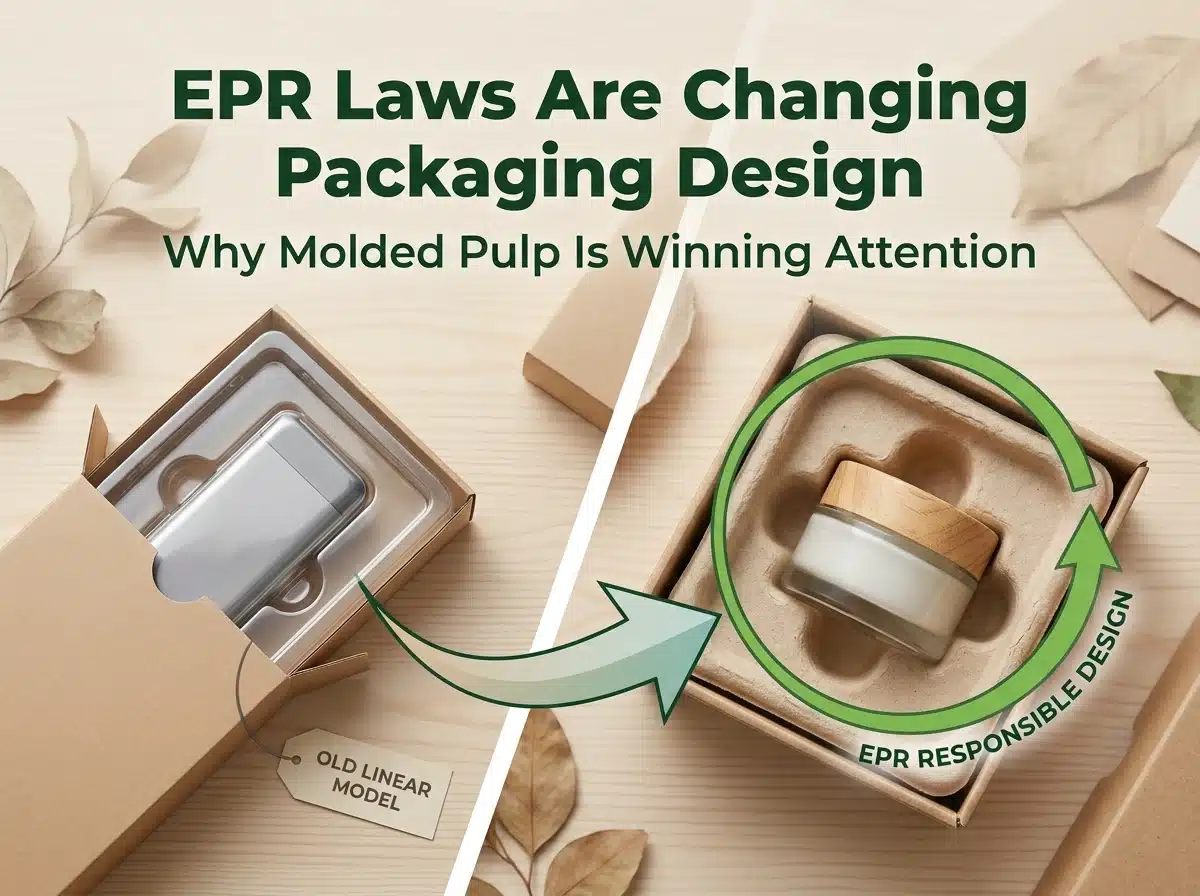
EPR laws are changing the packaging conversation in a very practical way. Packaging is no longer judged only by how much it costs to buy or how good it looks on the shelf. More brands now have to think about what happens after the customer opens the box, throws away the insert, or separates the materials. That is one reason molded pulp packaging is getting more attention.
What EPR Means for Packaging Design
EPR stands for Extended Producer Responsibility. In simple terms, it means producers carry more responsibility for the packaging they place on the market, including what happens to that packaging after use.
For packaging teams, this changes the starting point. A brand can no longer treat the insert, tray, sleeve, label, and box as separate purchasing decisions. The whole packaging system may become part of a reporting, fee, recycling, or compliance conversation.
That does not mean every brand needs to panic. It does mean packaging needs cleaner logic. Fewer unnecessary materials. Easier separation. Better recyclability. More specific claims. Less dependence on materials that are hard to explain.
The quiet change is this: packaging design is becoming connected to packaging responsibility. A beautiful structure still matters, but brands also need to explain why each material is there.
This is where molded pulp packaging can be useful. It gives brands a paper-based option for inserts, trays, protective structures, and product holders that may otherwise default to plastic or foam.
The Packaging Cost Iceberg
A packaging decision used to look simple on a quotation sheet. Material cost. Tooling cost. Printing cost. Freight. Lead time.
EPR makes the hidden part larger. A low-cost plastic tray may still be cheap to buy, but the brand also has to consider reporting, disposal expectations, recyclability questions, retailer review, and whether the material choice fits the sustainability story.
What brands see first vs. what EPR makes harder to ignore
|
Visible cost
|
Unit price, tooling, printing, finishing, freight, sampling, and assembly time.
|
|
|
Hidden responsibility
|
Material reporting, recyclability review, disposal fees, importer questions, retailer sustainability standards, and customer perception.
|
This is why the cheapest insert is not always the lowest-risk insert. The better choice is often the one that performs well and makes the packaging story easier to defend.
How EPR Changes the Design Brief
A normal packaging brief may ask for the box size, product weight, brand colors, printing method, finish, and target cost. An EPR-aware packaging brief goes further.
It asks what the package is made from. Whether the materials can be separated. Whether the insert is necessary. Whether plastic can be reduced. Whether the disposal claim is specific. Whether the brand can explain the structure to a buyer or importer without sounding vague.
| Old packaging brief |
EPR-aware packaging brief |
| Make the product look premium. |
Make it look premium with a structure that is easier to explain and separate. |
| Use a tray that holds the product tightly. |
Use the simplest material that can hold the product safely and support the packaging claim. |
| Keep the unit cost low. |
Compare unit cost with material responsibility, buyer review, and potential redesign risk. |
| Add an eco message if possible. |
Use specific material facts instead of broad sustainability language. |
This shift does not remove creativity. It gives creativity boundaries. In many cases, those boundaries lead to better packaging because the design has to be more disciplined from the beginning.
Why Molded Pulp Fits the EPR Direction
Molded pulp is not the answer to every EPR question. It still needs testing, tooling, product fit checks, and honest material claims.
But it fits the direction of EPR because it can reduce visible plastic, simplify the material story, and help brands move toward paper-based packaging systems. For many dry products, it can replace plastic trays, foam pads, or mixed-material inserts without making the packaging look unfinished.
Where molded pulp can help under EPR pressure
| ✓ |
Replaces some plastic or foam inserts in dry product categories.
|
| ✓ |
Creates a more consistent paper-based packaging story when paired with paper boxes.
|
| ✓ |
Can be shaped around the product instead of simply filling empty space.
|
| ✓ |
Makes sustainability claims easier to keep specific: fiber-based insert, molded paper tray, reduced plastic, or paper-based protection.
|
The biggest mistake is treating molded pulp as a direct copy of plastic. It is not. A molded fiber insert has different thickness, texture, tolerance, surface behavior, and product contact points. It has to be designed as its own structure.
A Simple EPR Risk Matrix for Packaging Inserts
The matrix below is a practical way to think about packaging insert risk. It is not a legal assessment. It is a design review tool.
| Insert type |
EPR review risk |
Why it matters |
| Foam insert |
Higher |
Often harder to align with recyclable paper packaging claims. |
| Plastic tray |
Medium to higher |
May be justified for moisture, precision, or product safety, but the reason should be clear. |
| Folded paperboard insert |
Lower |
Good for simple separation, light products, and paper-based packaging systems. |
| Molded pulp insert |
Lower with testing |
Useful when the brand needs shaped protection, reduced plastic, and a clearer fiber-based story. |
The Material Ledger: A Useful Exercise Before Redesign
Before changing a package, brands should write down what is actually inside it. This sounds basic. It often reveals the problem quickly.
A box may be called “paper packaging,” but the full structure could include coated paper, plastic tray, foam pad, magnet, ribbon, label, shrink film, and glue. EPR pressure makes that full list more important.
Example packaging material ledger
| Component |
Current material |
Review question |
| Outer box |
Paperboard |
Is the coating or lamination necessary? |
| Product tray |
Plastic |
Can molded pulp or folded paperboard hold the product safely? |
| Protective pad |
Foam |
Can the insert design remove the need for foam? |
| Decorative closure |
Magnet or ribbon |
Does it add real value or just more material complexity? |
This exercise does not automatically remove every non-paper material. It simply makes the decision visible. Once the material list is visible, the brand can decide what deserves to stay.
When Molded Pulp Is Not Enough
Some products still need more than molded pulp. Oily formulas, wet refills, sharp metal pieces, very heavy products, and delicate surfaces may require coatings, liners, films, or another protective solution.
That is not a failure of molded pulp. It is a reminder that sustainable packaging still has to protect the product. A damaged product is not sustainable, no matter how good the insert looks.
The goal is not to force every product into the same fiber tray. The goal is to reduce unnecessary complexity where the product allows it, and to keep the remaining materials easy to explain.
How GVPAK Helps Brands Review EPR-Ready Packaging
At GVPAK, we usually begin with the product and the market. A skincare jar for retail display does not need the same insert as a glass fragrance bottle shipped through e-commerce. A candle gift set does not have the same risk profile as an oily refill pouch.
From there, we compare paperboard, molded pulp, molded fiber, and hybrid insert structures. The question is not which material sounds best. The question is which structure protects the product, supports the brand, and gives the packaging a clearer material story.
GVPAK review points for EPR-aware packaging
01 Identify every material in the current package.
02 Find the components that create the biggest sustainability mismatch.
03 Test paper-based alternatives before changing the full structure.
04 Check product protection, surface contact, drop performance, and packing efficiency.
05 Keep the sustainability claim specific and supported by the actual material choice.
Final Thought: EPR Rewards Packaging That Makes Sense
EPR laws are not only changing paperwork. They are changing design habits.
Packaging that once passed because it looked good may now be reviewed for material choice, recyclability, separation, disposal, and responsibility. That does not make packaging less creative. It makes the design brief more serious.
Molded pulp packaging fits this shift because it gives brands a way to reduce visible plastic, create shaped protection, and build a clearer fiber-based packaging story. It still needs testing. It still needs honest claims. But for many brands, it is becoming a practical place to start.
For brands reviewing EPR-ready sustainable packaging, GVPAK can help compare molded pulp, molded fiber, paperboard, and hybrid insert options before packaging responsibility becomes a rushed redesign problem.