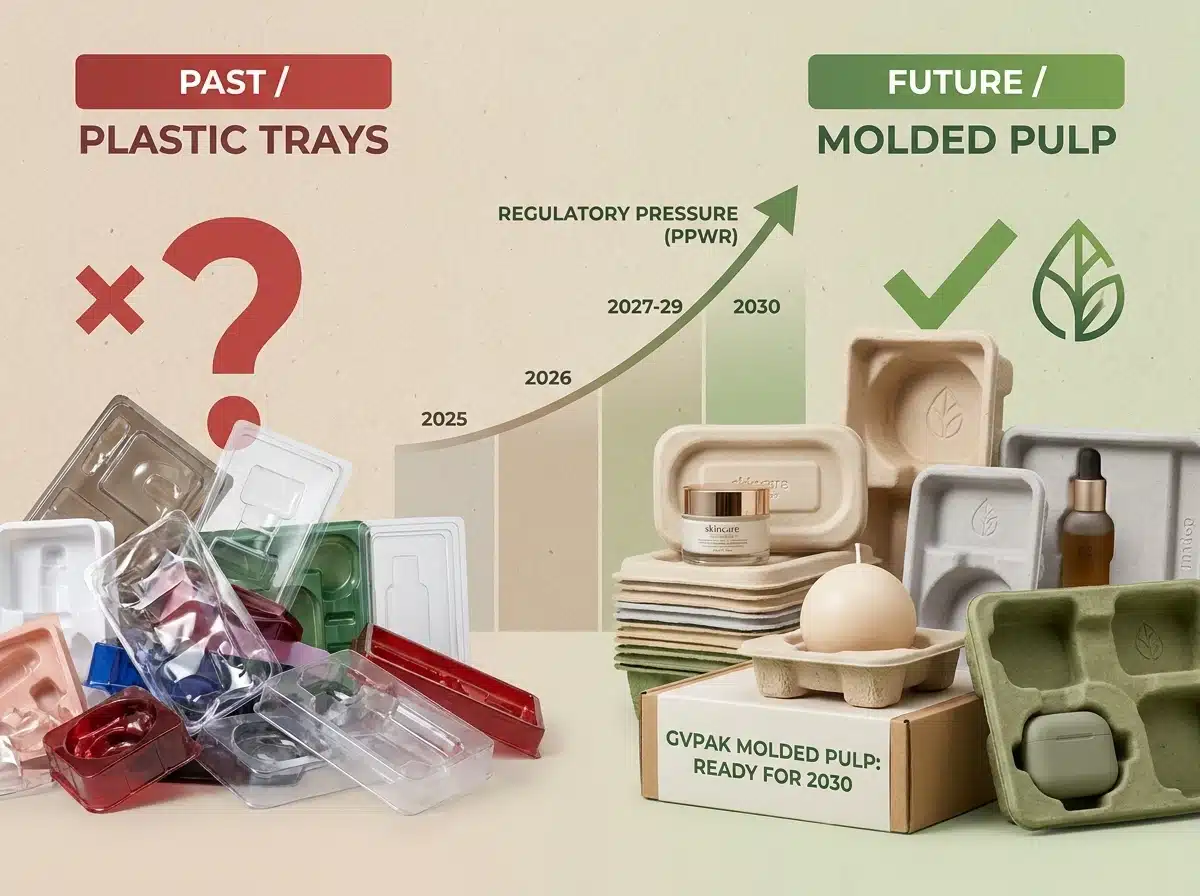
2030 sounds far away until a packaging team starts counting backwards. Product launch. Retail review. Tooling. Sampling. Compliance checks. Reorders. For brands still using plastic trays or mixed-material inserts, molded pulp packaging is no longer just an eco option. It is becoming a cleaner way to prepare for the next round of packaging scrutiny.
The 2030 Packaging Question Is Already Here
A few years ago, many brands treated inner packaging as a hidden component. The outer box carried the brand message. The insert simply held the product in place.
That separation is harder to maintain now. Retail buyers, importers, and sustainability teams are starting to look at the whole package: box, tray, sleeve, coating, label, filler, and insert. If one part is difficult to recycle or difficult to explain, the entire packaging story becomes weaker.
The EU Packaging and Packaging Waste Regulation, or PPWR, entered into force in 2025 and will generally apply from 12 August 2026. One of the big signals is clear: by 2030, packaging placed on the EU market is expected to move toward economically viable recyclability.
For brands, the practical question is not only “Is this package attractive?” It is becoming: can this packaging structure be justified when someone asks what it is made from, how it separates, and whether the material choice still makes sense in 2030?
This is where molded pulp packaging becomes more interesting. A fiber-based insert can reduce visible plastic, support a paper-based packaging system, and make the material logic easier to explain.
A Simple Timeline for Brands Preparing for 2030
Regulation does not usually change packaging overnight. It changes the questions buyers ask first. Then it changes approval processes. Then it changes what brands consider normal.
| 2025 |
PPWR enters into force
Packaging starts moving from voluntary sustainability language toward clearer regulatory expectations.
|
| 2026 |
Application period begins
Brands, importers, and suppliers start paying closer attention to material choice, documentation, and packaging design logic.
|
| 2027–29 |
Retail and importer pressure increases
The packaging review moves upstream. Insert materials, coatings, plastic trays, and mixed structures may face earlier questions.
|
| 2030 |
Recyclability becomes harder to avoid
Packaging structures that are simpler, fiber-based, and easier to explain may have a clear advantage.
|
Why Fiber-Based Inserts Are Becoming a Compliance Advantage
A compliance advantage does not mean a material is automatically approved everywhere. It means the packaging choice is easier to defend, easier to document, and easier to align with the direction of the market.
That is the quiet strength of molded pulp and molded fiber inserts. They do not solve every packaging problem, but they can simplify a lot of conversations.
|
①
Clearer material story
A paper box with a fiber-based insert feels more consistent than a paper box hiding a glossy plastic tray.
|
|
②
Lower visible plastic
For many dry products, molded pulp can replace foam or plastic trays without making the package look unfinished.
|
|
③
Better design discipline
The insert has to be designed around the product, not chosen as a default tray after the box is finished.
|
|
④
More credible sustainability claims
Specific material facts are easier to defend than broad phrases like “green” or “eco-friendly.”
|
This does not mean every product should move to molded pulp immediately. It means brands should stop treating plastic trays as the automatic starting point.
The 2030 Pressure Curve
The chart below is a GVPAK editorial model, not a legal rating. It shows how we expect pressure on packaging inserts to increase as brands get closer to 2030. The point is simple: the earlier a brand tests alternatives, the more calmly it can make decisions.
Estimated pressure on mixed-material inserts, 2026–2030
Editorial model: 1 = low pressure · 5 = high pressure
| 2026 |
|
1.6 |
| 2027 |
|
2.2 |
| 2028 |
|
3.1 |
| 2029 |
|
4.0 |
| 2030 |
|
4.7 |
The pressure is not only legal. It also comes from retail buyers, consumers, importers, sustainability reports, and internal brand standards.
Where Molded Pulp Works Best
Molded pulp is strongest when the product is dry, stable, and needs both protection and presentation. It is especially useful when the brand wants the inside of the package to feel as considered as the outside.
Categories such as skincare, fragrance, candles, wellness products, electronics accessories, gift sets, and refillable products often fit this direction. The insert can be shaped around the product, colored to match the brand, and designed with a cleaner material story than many plastic trays.
| Product type |
Molded pulp fit |
Main check |
| Skincare jars |
Strong |
Scuffing and product fit |
| Perfume bottles |
Good with testing |
Glass stability and drop test |
| Candles |
Strong |
Weight and edge support |
| Electronics accessories |
Case by case |
Tolerance and surface contact |
| Oily or wet products |
Needs caution |
Moisture, oil, and coating needs |
This is why early testing matters. A molded pulp insert that works beautifully for a candle may not work for a wet cosmetic refill. A black molded fiber tray may look premium in a sample photo but still need testing for dust, rubbing, and surface marks.
The Risk of Waiting Too Long
Packaging redesign is slow when it is done properly. A new insert may need a new mold, new box dimensions, revised artwork, fresh samples, updated drop testing, and new packing instructions.
If a brand waits until a buyer asks for lower-plastic packaging, the redesign becomes urgent. Urgent packaging decisions are rarely the best packaging decisions.
|
Waiting until 2029
- Less time for testing
- Higher launch pressure
- More rushed tooling decisions
- Greater risk of buyer pushback
|
|
Starting now
- More sample rounds
- Better product fit
- Calmer material comparison
- Cleaner packaging story
|
In our experience, brands do not need to redesign everything at once. A more realistic approach is to start with the packaging components that create the biggest mismatch: plastic trays inside paper boxes, foam inserts inside eco-positioned products, or oversized structures that make the package look wasteful.
How GVPAK Looks at Molded Pulp Projects
At GVPAK, we do not start by asking whether molded pulp sounds sustainable. We start with the product.
What is the product weight? Is it fragile? Does it have a painted surface? Is it glass? Does it leak? Will customers remove it once, or will they use the package for storage? Does the brand want the insert to be visible as a sustainability feature, or quiet and premium?
The answers shape the insert. Sometimes molded pulp is the right direction. Sometimes folded paperboard is enough. Sometimes a hybrid structure is more practical. Occasionally, plastic still has a reason to stay.
GVPAK project questions before recommending molded pulp
✓ Can the insert protect the real product, not just look good in a sample?
✓ Does the surface texture match the brand’s price point?
✓ Will the product rub against the fiber during transport?
✓ Can the outer box and molded insert be designed as one system?
✓ Can the material claim be explained without vague sustainability language?
What Brands Should Review Before 2030
A simple audit can reveal which packaging components should be redesigned first. Brands do not need to wait for a formal compliance review to begin this work.
| Insert material |
Is the insert paper-based, plastic, foam, or a mixed-material structure? |
| Product fit |
Can a fiber-based insert hold the product securely without scuffing or movement? |
| Material logic |
Does the insert support or contradict the outer packaging story? |
| Testing need |
What needs to be checked: drop, compression, rubbing, moisture, dust, or assembly speed? |
| Claim accuracy |
Can the brand describe the material clearly without relying on broad eco language? |
Final Thought: Compliance Advantage Comes From Simpler Logic
Molded pulp packaging is not a shortcut around regulation. It still needs testing. It still needs the right product fit. It still needs good tooling, controlled texture, and honest claims.
Its advantage is simpler than that. It can make the packaging structure easier to understand.
A paper box with a well-designed fiber insert has a clearer story than a paper box with a plastic tray added by habit. It looks more consistent. It feels more intentional. And when buyers begin asking sharper questions before 2030, it gives the brand a better starting point.
For brands preparing for the next generation of custom sustainable packaging, GVPAK can help review molded pulp, molded fiber, folded paperboard, and hybrid insert options before the decision becomes urgent.