Approving molded pulp in a humid supply chain is not a question of whether paper-based packaging "handles humidity." It is a question of whether one specific construction, made to one specific geometry, still meets your fit and protection requirements after the exposure your route and warehouse actually create. That answer belongs to your project, not to an industry-wide relative-humidity figure you can copy into a purchase order.
The practical approach is to treat molded pulp packaging humidity as four separate variables: moisture in the air, moisture already in the pack, exposure duration, and temperature. Agree on the construction, the conditioning procedure, the measurements and the pass criteria before anyone signs off a sample.
Separate the kinds of moisture exposure your pack will face
"Humid" covers several different problems, and they do not call for the same response. A pack that sits for weeks in a warm, high-humidity warehouse is dealing with slow moisture uptake through the air. A pack that travels through a cold container and then enters a warm, damp building may see condensation on surfaces that were previously dry. A pack that is stored near a loading door, a leaking roof or wet pallets faces direct liquid water, which is a different risk from humid air.
The duration matters as much as the level. A few days in a humid port is not the same event as a full rainy season in an unconditioned warehouse. Temperature changes the package's moisture equilibrium and can raise condensation risk during cold-to-warm transitions.
This is why you should be cautious about any single number presented as the humidity limit for molded pulp. Fiber-based materials respond to moisture, and that response is shaped by the material, the geometry, the coating or finish, the stacked load and the product being held. A storage recommendation written for one producer's named product line is useful as an example of what to ask for, not as a default limit for yours.
Write a warehouse and transport brief before you request samples
Many humidity disputes trace back to a vague brief. A buyer says "tropical destination" and the supplier tests nothing in particular, or tests something that does not match where the goods will sit.
Instead, describe the actual conditions. Where will the product be stored after arrival: a climate-controlled distribution center, an open-air warehouse, a shop back room? How long is the expected dwell time before use? Will pallets be double-stacked, so the bottom trays carry extra compression? Does the pack ship inside an outer carton with a liner, or exposed on a shelf? Which product surfaces are sensitive to moisture, marking or condensation: polished metal, printed labels, electronics, coated board, food contact areas?
Route geography helps, but country names alone are weak substitutes for real conditions. Two destinations in the same country can differ entirely between a modern port warehouse and an older inland depot. Where possible, ask your logistics team or the receiving customer for recorded temperature and relative-humidity ranges during distribution. Distribution measurement is a recognized input for selecting and interpreting packaging tests.
Confirm the exact pulp construction and finish under consideration
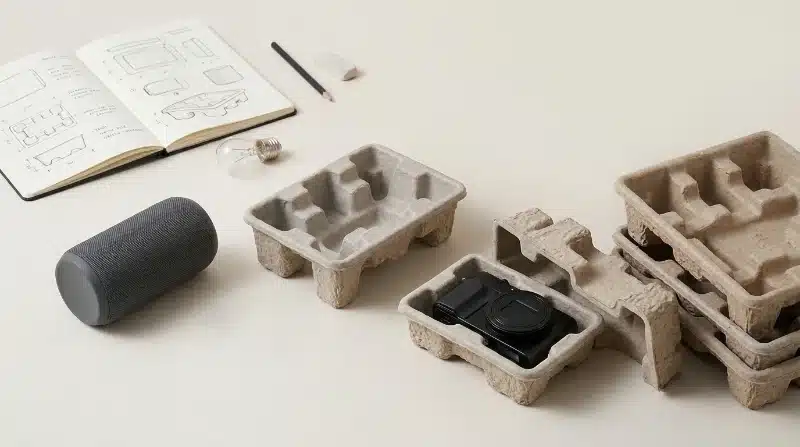
Molded pulp is a family of products, not a single material. Options can differ in fiber source and color, and the inner tray or insert may use molded pulp, paperboard, compressed honeycomb or recycled PET, with different closure formats. Electronics packaging, for example, may be offered in wood, sugarcane bagasse or bamboo pulp. These construction choices give you different configurations to identify and test, so the specification on the approval record needs to name the actual construction (fiber type, color, coating or finish if any, wall layout and geometry) rather than saying "molded pulp."
Ask the supplier three questions in writing:
- What exactly is the proposed construction, including any coating, additive or surface treatment, and what does each component do?
- What storage conditions does the supplier recommend for this specific item before it is packed, and are those recommendations product-specific or general?
- What is the packed state the supplier expects at handover? For instance, is the pulp supplied dry and wrapped, and how should the carton be stored before use?
Treat the answers as inputs to your own verification, not as proof of performance. A supplier's storage range for its own named products is a legitimate reference point for your discussion, but it does not establish a universal RH tolerance for every molded pulp pack, and it says nothing about how your product will behave inside the pack. Ask the supplier to state any moisture-resistance limits and the evidence for the exact construction. Do not infer waterproof or mold-resistant performance from the material name.
Agree on conditioning and acceptance criteria before testing
Once you know the construction and the exposure, you can design a conditioning step. A conditioning atmosphere is intended to bring samples toward equilibrium with a defined temperature and relative humidity that simulates a field condition, and such conditioning is commonly paired with transit simulation tests. Its limits matter: laboratory conditions relate to field performance but do not necessarily duplicate it, so conditioning is an input to the test, not a substitute for realistic handling and storage.
Standards are useful here as methods, not certificates. ASTM D4332-22 describes conditioning practices for containers, packages and packaging components and explains why cellulosic materials in particular change physical properties as temperature and relative humidity vary. ISTA's design-and-testing guidance notes that test selection and interpretation should reflect the actual distribution flow, handling and storage, and that temperature and humidity may be measured during distribution to inform that selection. Neither document certifies your pack or approves it for your product. Using them does not convert a sample result into a general performance claim.
Before any sample goes into conditioning, write down the pass criteria. What dimensions or fit clearances must hold? How much warpage or bowing is acceptable? What minimum compression or retention must the assembled pack maintain? What surface condition (marking, staining, fiber transfer, condensation residue) would count as a failure? What about the product itself, including labels and printed areas that sit against the pulp? A test without predefined criteria tends to produce a debate rather than a decision.
Compare exposures, inputs and evidence in one place
The table below is a planning tool. It organizes what you should specify and what evidence you should receive. It deliberately contains no numeric performance promises, because those must come from testing your actual pack.
Test the assembled pack, not an isolated tray
A bare tray that measures well after conditioning tells you only part of the story. In service, the pulp insert sits in an outer carton, holds the product, may be stacked, and is handled repeatedly. Fit and retention can change when fiber takes up moisture, and a small geometry change at a contact point can matter more than a large change somewhere harmless. For fragile or precision items, the interaction between the insert and the product is the part most worth checking. Your customer will open the assembled system, not the tray alone.
So condition and test the complete pack configuration you intend to ship: pulp insert, any liner or inner tray, outer carton, and the actual product or a representative weight and surface. Check the same measurements at defined points: before conditioning, after conditioning and equilibration, and after the handling or transit simulation. Photograph contact points and any surface changes. Where the product itself is sensitive, include it rather than a dummy, or explain on the record why a substitute was used.
For the general prototype workflow, use the molded-fiber prototype approval guide. This humidity review adds route-specific exposure, conditioning and acceptance records to that workflow.
Record the result before production approval
Approval should rest on a documented result, not a recollection of a sample that "seemed fine." Keep the approval record tied to the specific construction and the specific test conditions, so that a later material or geometry change triggers a fresh review rather than an assumption that the old result still applies.
Buyer checklist for humid-route molded pulp approval
- [ ] Written use-condition brief covering destination, warehouse type, dwell time, stacking and any condensation or water exposure.
- [ ] Named construction: fiber type, color, coating or finish, wall layout and geometry version.
- [ ] Supplier storage recommendations for the actual item, clearly marked as product-specific or general.
- [ ] Confirmation of what the supplier does and does not claim about moisture, waterproofing and mold resistance.
- [ ] Conditioning procedure with temperature, relative humidity and duration, referencing a recognized method where appropriate.
- [ ] Pass criteria defined in advance for dimensions, warpage, compression/retention, surface condition and product contact points.
- [ ] Testing on the assembled pack, with product or a justified substitute.
- [ ] Sample and batch IDs, measurement methods and before/after readings recorded.
- [ ] Photographs of contact points and surface changes.
- [ ] A named approver and a clear statement of which construction and conditions the approval covers.
- [ ] A change-control note: any material, coating or geometry change reopens the humidity review.
What to put in the RFQ
When you approach a supplier, give enough detail to make the answer specific: product dimensions and weight, the market and destination, expected storage and transit conditions, stacking and outer-carton plan, any sensitive product surfaces, required documentation, and the sample and test support you expect. Ask the supplier to state which pulp constructions and finishes it can offer for your application. For example, the custom molded pulp packaging range lists options across pulp colors, printing methods and inner-tray materials, and the eco-friendly electronics packaging page describes wood, sugarcane bagasse and bamboo pulp options for that category. Use those as starting points for a specification discussion, not as evidence of humidity performance.
Keep the approval tied to a defined construction, exposure and recorded result, so later changes can be reviewed against the same requirements.
If you have a humid storage or shipping route in mind, send your product dimensions, expected order quantity, destination market and the storage or transit conditions you need to cover. That gives both sides something concrete to evaluate.