








A few years ago, when people heard “molded pulp,” most of them pictured egg cartons. Functional, yes. Exciting, not really. That picture is out of date now. In 2026, molded pulp packaging sits at the center of a multi-billion-dollar shift — one driven less by eco-marketing and more by hard regulation, supply-chain math, and a generation of buyers who want proof behind every sustainability claim.
The Numbers: Where the Market Stands Right Now
Market sizing varies across research houses — different scoping and segmentation will do that. But the direction is unanimous: molded pulp packaging is on a sustained growth path with no sign of flattening.
Mordor Intelligence values the global molded pulp packaging market at USD 5.71 billion in 2026, projecting it to reach USD 7.05 billion by 2031 at a 4.31% CAGR. Towards Packaging’s estimate runs higher — USD 6.95 billion in 2026, growing to USD 13.27 billion by 2035 at 7.45% CAGR. Grand View Research sits somewhere in the middle with a 6.3% CAGR through 2033.
The point isn’t which number is “right.” It’s that every major research firm is telling the same story: steady, structural growth, not a short-term spike.
| Source | 2026 Value | Projected To | CAGR |
|---|---|---|---|
| Mordor Intelligence | $5.71B | $7.05B by 2031 | 4.31% |
| Towards Packaging | $6.95B | $13.27B by 2035 | 7.45% |
| Grand View Research | $6.65B | $10.18B by 2033 | 6.3% |
| Smithers | $4.7B | $5.5B by 2030 | 4.2% |
| Fortune Business Insights | $9.80B* | $16.10B by 2034 | 6.41% |
*Fortune Business Insights uses a broader “molded fiber packaging” scope that includes additional product categories.
What’s Actually Driving This Growth
It would be easy to chalk all of this up to “the world going green.” But the real drivers are more specific — and more urgent — than general sustainability sentiment.
Regulation Is Forcing the Conversation
The EU’s Packaging and Packaging Waste Regulation (PPWR) will apply from August 12, 2026 across all 27 member states. It’s not a guideline. It’s a direct regulation — no national transposition, no local variation. Every packaging format placed on the EU market after that date must meet new requirements around recyclability, substance restrictions, labeling, and documentation.
For molded pulp specifically, the PPWR introduces strict PFAS limits for food-contact packaging: 25 ppb for any single PFAS compound, 250 ppb for the sum of targeted PFAS, and 50 ppm for total fluorine. That’s a hard technical line that every molded fiber lid, tray, bowl, and clamshell needs to clear.
Meanwhile, in the U.S., California’s SB 54 permanent regulations went into effect on May 1, 2026. Extended Producer Responsibility programs are expanding across multiple states. Maine is refining EPR scoring rules that could give uncoated molded fiber a favorable position relative to hard-to-recycle alternatives.
The bottom line: packaging decisions that were once about brand preference are now about market access and compliance cost.
Plastic Bans Keep Expanding
More than 100 countries have some form of restriction on single-use plastics. The EU’s 2030 recyclability rules and California’s SB 54 both target expanded polystyrene (EPS) directly. For product categories that have relied on EPS for decades — takeaway food, electronics cushioning, protective inserts — molded pulp is no longer a nice-to-have alternative. It’s becoming a compliance necessity.
E-Commerce Keeps Asking for Better Packaging
Online retail creates a specific packaging problem: products travel farther, get handled more, and arrive at someone’s front door where the unboxing experience is part of the brand. Traditional foam and plastic void-fill are getting replaced by engineered pulp cushions that can pass ISTA transit tests while being curbside recyclable. For higher-value consumer electronics and delicate goods, molded fiber inserts offer protection and a cleaner brand message at the same time.
Where Is the Growth Happening?
Not everywhere equally. The growth picture is layered by geography, application, and technology type.
By Region
Asia-Pacific leads global production capacity and accounts for the largest regional share. China alone is projected to grow at an 8.3% CAGR, driven by takeaway food delivery, beverage packaging, and consumer electronics. India follows at 8.0%, fueled by quick-service restaurants and packaged food brands. North America holds the largest consumption share in terms of revenue — over 46% of global sales in 2025, according to Mordor Intelligence — but the fastest future growth may come from the Middle East, forecast at 8.4% CAGR to 2031 thanks to Saudi Arabia’s Vision 2030 and UAE circular-economy policies.
By Application
Food packaging remains the largest segment, accounting for over 52% of demand in 2025. But the fastest-growing segment might surprise you: healthcare and medical devices, projected at an 8.6% CAGR. Sterile-barrier requirements, PFAS bans in medical packaging, and the global trend toward single-use surgical devices are all pulling molded fiber into higher-specification territory.
Electronics is another bright spot. Brands are replacing EPS inserts with molded pulp solutions that perform as well in drop tests while looking substantially better when a customer opens the box.
By Technology
Transfer molding is still the workhorse — about 36.7% of volume in 2025. But thermoformed molded pulp is catching up fast, projected at a 7.4% CAGR. Thermoforming delivers smoother surfaces, tighter tolerances, and a more premium feel. That’s what makes it the go-to for cosmetics, consumer electronics, and any application where the packaging needs to look as good as it protects.
| Segment | Current Status | Growth Outlook |
|---|---|---|
| Food packaging | 52.4% of demand (2025) | Steady — EPS phase-outs accelerating |
| Healthcare & medical | Growing fast | 8.6% CAGR — PFAS bans + sterile barrier needs |
| Consumer electronics | Replacing EPS & foam | Strong — premium unboxing + transit protection |
| Thermoformed pulp | ~37% volume share | 7.4% CAGR — smoother finish, premium applications |
| Non-wood pulp sources | Emerging | 7.5% CAGR — bagasse, bamboo, agricultural waste |
Technology Watch: Dry Molded Fiber Changes the Equation
One development worth paying close attention to is dry molded fiber — a process pioneered by Swedish company PulPac that forms cellulose fibers into 3D packaging shapes without water. Traditional wet-molding uses large amounts of water and energy for drying. PulPac’s process skips that entirely, and the company claims up to 90% less water and energy compared to conventional fiber-forming methods.
In April 2026, PulPac announced that its intellectual property portfolio had surpassed 500 national patent grants globally. Their COO, Viktor Wingård Börjesson, put it plainly: the technology has moved “from curiosity to commitment” in the market.
What makes this especially interesting is what PulPac showed at Interpack 2026 in Düsseldorf: fiber-based bottle caps that mimic the stiffness, threading, and tactile feel of plastic. According to PulPac, consumers in early tests couldn’t tell the caps were made from fiber. If that kind of performance scales, it opens up packaging categories — closures, blisters, rigid containers — that fiber hasn’t been able to touch before.
It’s not just caps and trays, either. The fiber-based packaging movement is reaching into liquid containers as well — GVPAK, for instance, has already brought a fully recyclable paper bottle to market, proving that cellulose-based structures can handle the performance demands of beverage and liquid packaging at commercial scale.
PulPac’s licensing model is also expanding. Zipform Packaging in Australia recently signed on to develop dry molded fiber meat trays for fresh food applications, with R&D funding from Meat & Livestock Australia. PulPac also partnered with SIG to develop fiber closures for aseptic cartons.
The PFAS Factor
PFAS — per- and polyfluoroalkyl substances, sometimes called “forever chemicals” — has become one of the most important technical issues in molded fiber packaging. Many molded pulp products used for food contact historically relied on PFAS-based coatings to achieve grease and moisture resistance. That’s changing fast.
California already bans intentionally added PFAS in food packaging. The EU’s PPWR introduces tiered PFAS concentration limits for food-contact packaging materials starting August 2026. For molded fiber specifically, this means brands and suppliers need to either switch to PFAS-free barrier chemistries or demonstrate compliance through third-party testing.
This isn’t a minor reformulation. It’s a supply-chain-wide shift. Brands selling into the EU will need supplier declarations, certificates of analysis, and fluorine test reports on file. Uncoated molded fiber has an advantage here — it often scores better in recyclability and EPR assessments precisely because it avoids the coating problem altogether.
From Commodity to Brand Asset
Here’s the part that doesn’t show up in market-size reports but matters just as much: molded pulp is being rethought as a brand experience tool, not just a protective material.
IndexBox’s 2026 forecast identifies a clear split forming in the market. On one side, there’s a high-volume, price-sensitive commodity segment — egg cartons, basic food trays, industrial cushioning. On the other, there’s a premium segment where packaging is part of brand storytelling, shelf presence, and the unboxing moment.
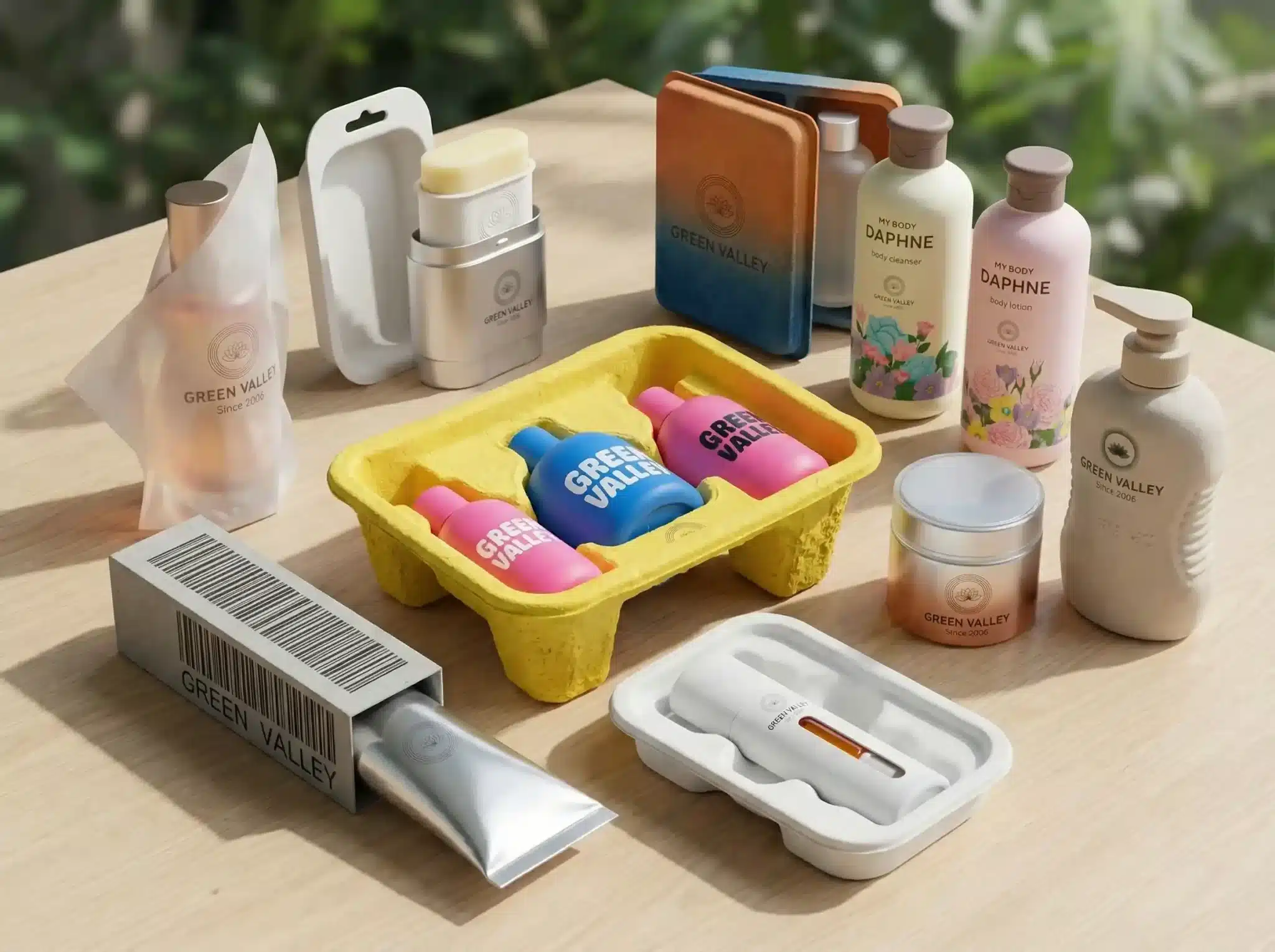
This second track is where things get creative. Thermoforming technology now delivers surfaces smooth enough for cosmetic packaging. Embossing, color printing on fiber, and precision cavity design are all catching up. Brands in beauty, fragrance, supplements, and premium electronics are exploring molded fiber not because they have to — though increasingly they do — but because it can actually look and feel better than overengineered plastic.
What Brand Teams and Buyers Should Watch Next
If you’re a brand manager, packaging designer, or procurement lead evaluating molded pulp options right now, here are the things worth tracking over the next 12 months:
PPWR enforcement details. The regulation applies from August 2026, but delegated acts on recyclability criteria and labeling formats are still rolling out. What counts as “recyclable in an economically viable way” will be defined more precisely through 2027, and that definition will directly impact which molded fiber formats qualify.
PFAS-free barrier innovation. Multiple suppliers are racing to commercialize grease and moisture barriers that don’t rely on fluorinated chemistry. Performance varies. Demand third-party migration data before committing, and make sure your supplier can document compliance for both EU and U.S. requirements.
Dry molding at scale. PulPac’s technology and its expanding licensee network could meaningfully change cost structures and design possibilities. If dry molded fiber achieves true industrial scale in the next two to three years, the competitive gap between molded pulp and injection-molded plastic will narrow further.
EPR cost structures. As more U.S. states and EU member states refine their EPR fee models, the real cost of different packaging materials will shift. Formats that are easier to recycle and better documented will likely face lower fees — giving well-designed molded fiber a potential cost advantage that goes beyond material price.
Premium application growth. Watch for more luxury and beauty brands adopting molded fiber for primary packaging, not just transit protection. The technology for premium-looking fiber packaging is now there. The question is whether brand teams will make the switch before regulations force the issue.
The Bigger Picture
Molded pulp packaging is not a trend. It’s an industry going through a structural upgrade — pushed by regulation, pulled by consumer expectations, and enabled by genuine manufacturing innovation. The egg-carton era isn’t over, but it’s no longer the whole story. Not even close.
For brands that need packaging to be recyclable, protective, good-looking, and compliant all at once, molded fiber is increasingly the material that checks the most boxes. The challenge now isn’t whether to consider it. It’s how to source it well, design it smart, and make credible claims about it without overreaching.
GVPAK specializes in molded pulp and luxury paper packaging for brands in beauty, fragrance, food, electronics, and beyond. If you’re exploring fiber-based packaging for an upcoming launch — or rethinking your current packaging structure — molded pulp packaging for a packaging consultation.

