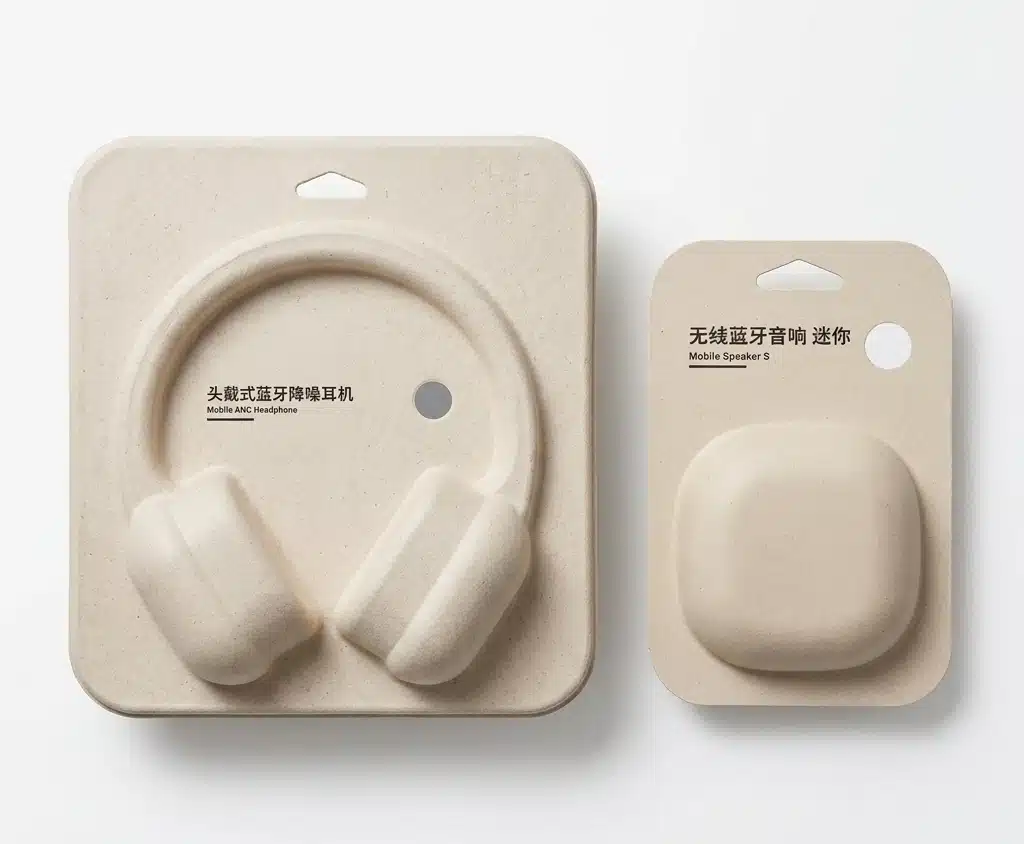
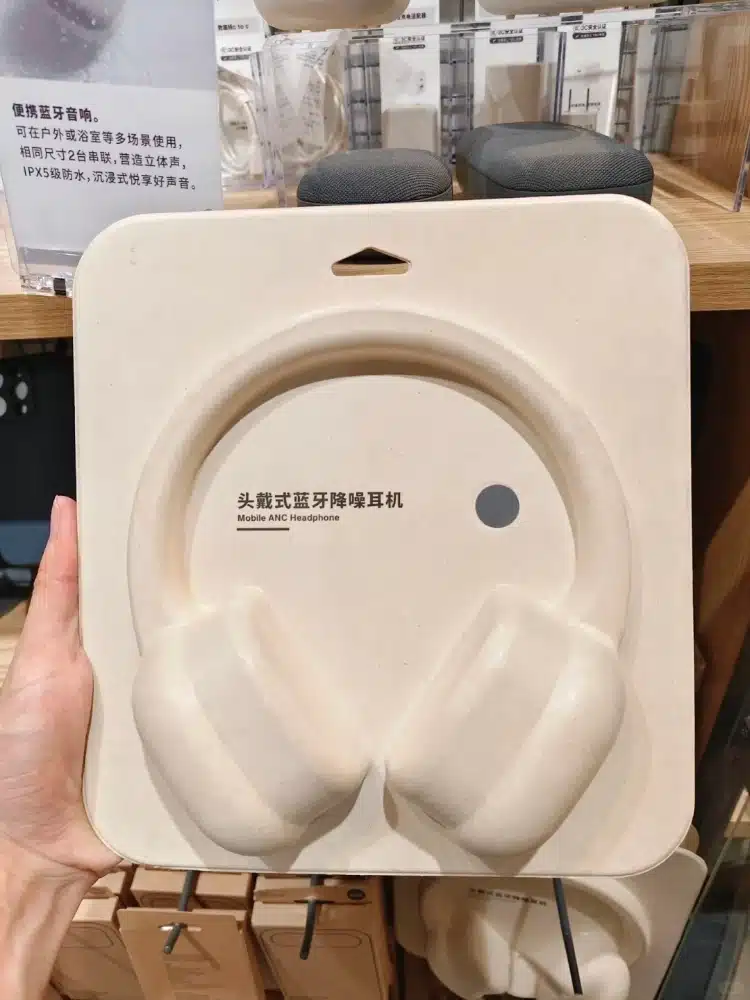
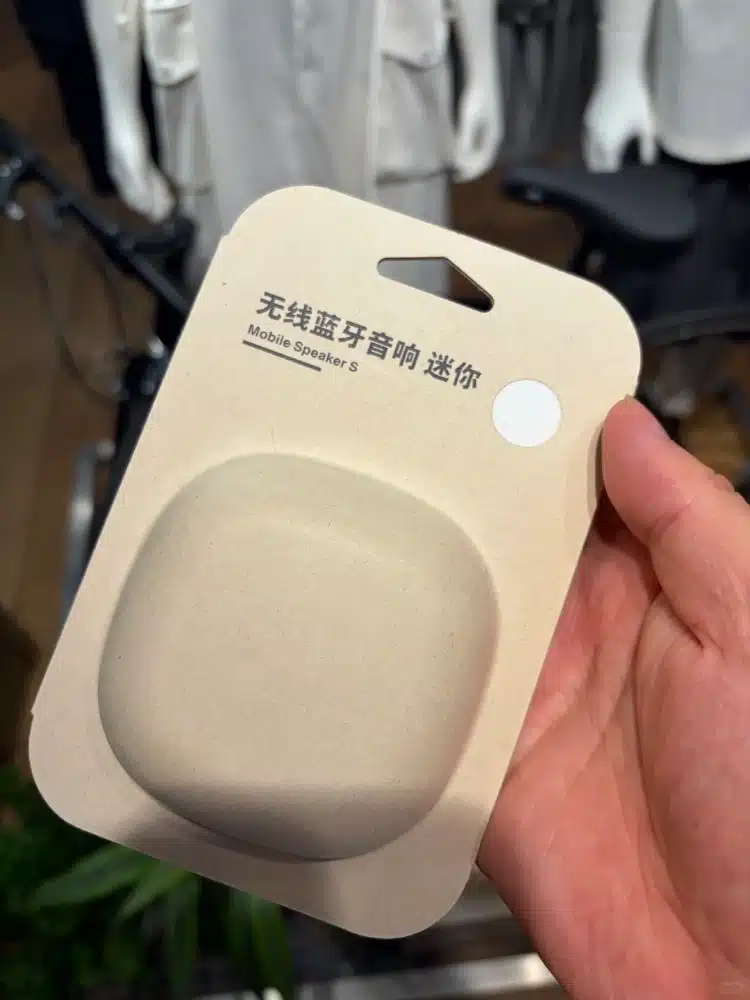
On the store shelf, a wireless Bluetooth speaker rests quietly inside a creamy-white paper inner tray.
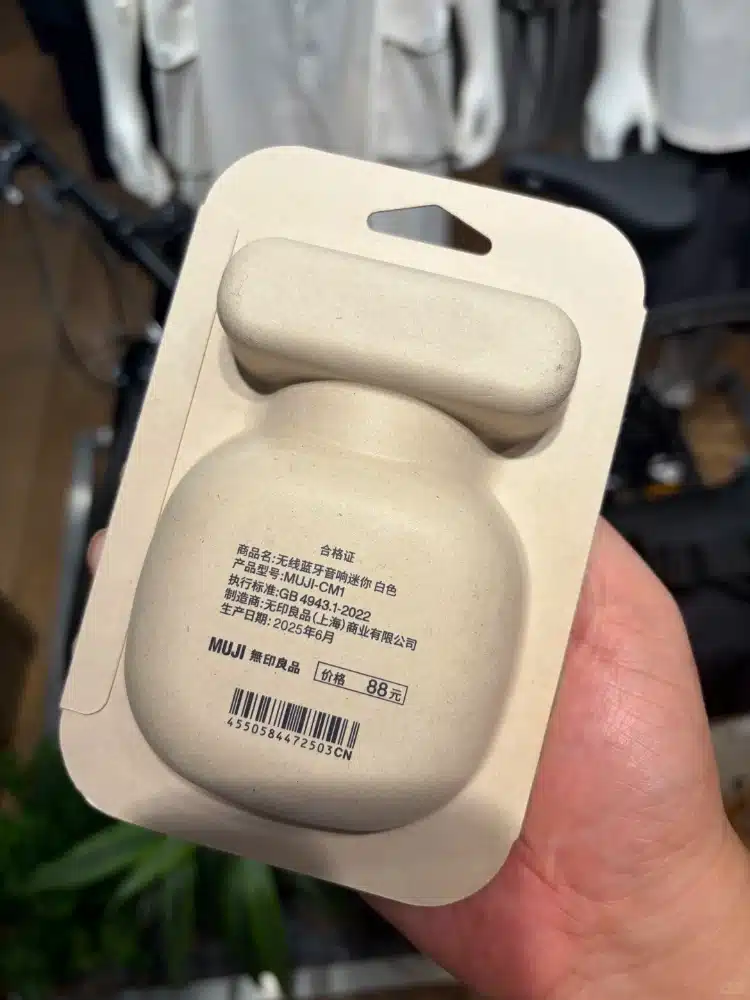
There is none of the cheapness associated with expanded polyethylene (EPE), no glossy glare from plastic films, and no redundant layers of packaging—just a single layer of precisely engineered molded pulp that contours perfectly to the speaker, its edges showcasing the delicate texture of natural fibers.
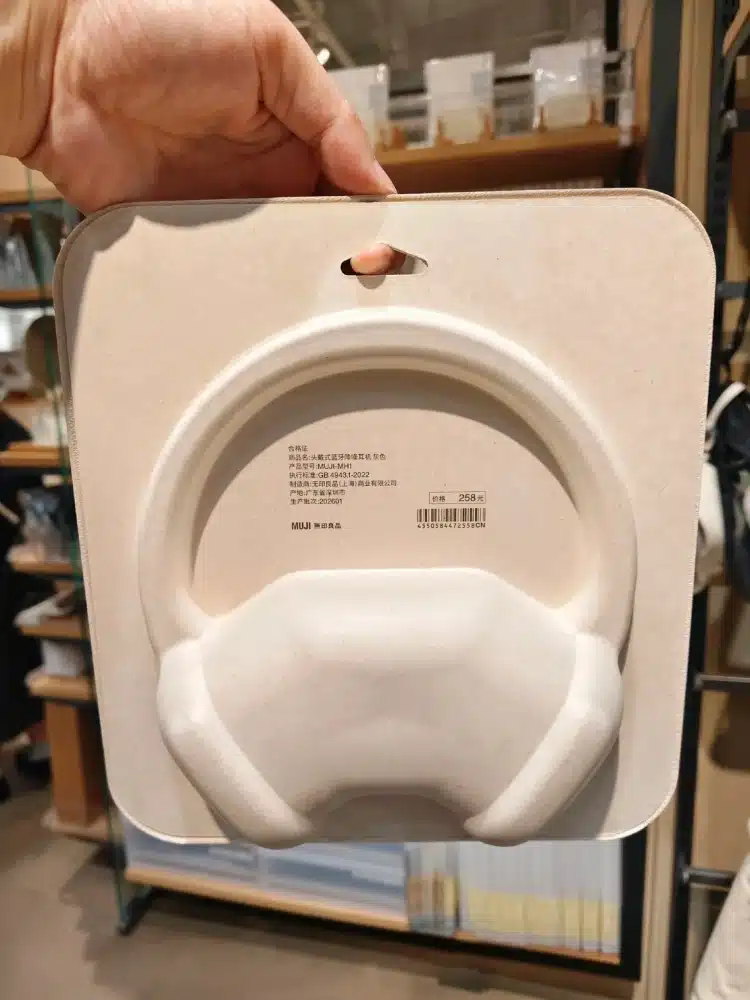
The certificate of conformity reads: Manufacturer: MUJI (Shanghai) Commercial Co., Ltd.
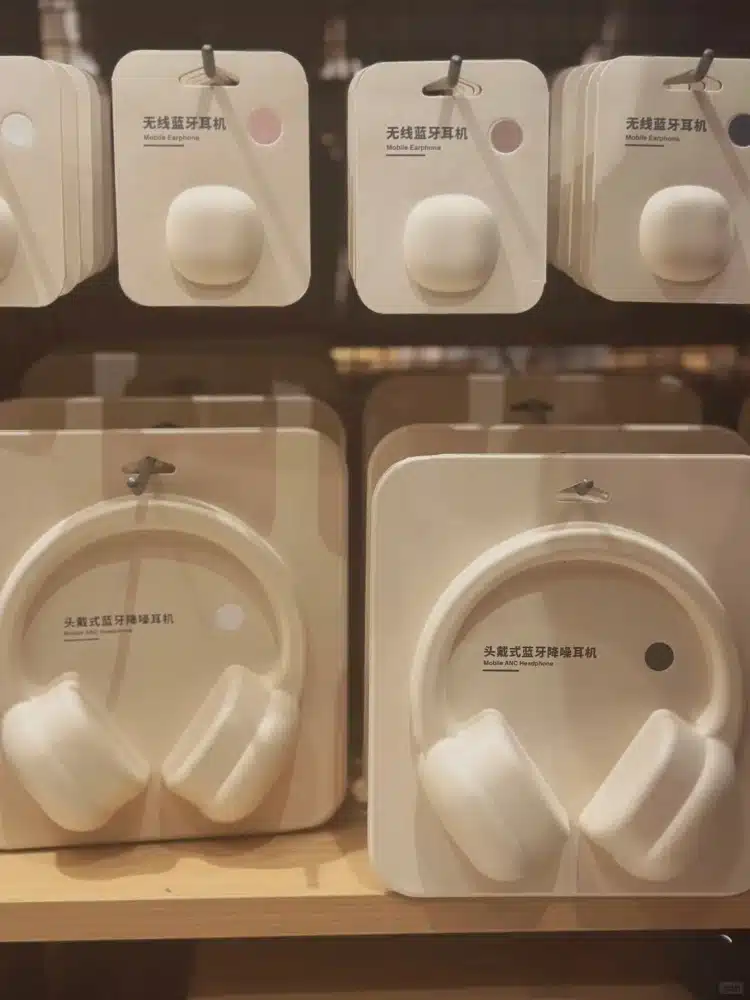
This is a microcosm of MUJI’s “de-plasticization” strategy, and quite possibly the mainstream form of consumer electronics packaging for the next decade, with headphone packaging leading the charge toward plastic-free design.
1. MUJI’s Plastic-Free Long March: Starting with a Single Tag Pin
When people think of MUJI’s environmental initiatives, “minimalist design” and “natural materials” are usually the first things that come to mind. Yet, few realize that in the details “hidden from sight,” MUJI is executing a thorough “de-plasticization” revolution.
According to the Ryohin Keikaku (MUJI’s parent company) 2025 ESG Report, as of August 2025, 93.5% of MUJI’s apparel packaging is entirely plastic-free. This means that when you buy MUJI underwear, socks, or scarves, the packaging has been completely switched to recycled paper or FSC-certified paper.
This revolution began with a tiny tag pin:
- From 2019: Sock display hooks were changed from plastic to recycled paper.
- From 2020: Innerwear packaging switched from plastic trays to paper-based materials, eliminating the plastic backing sheets used to maintain shape.
- From 2021: Tag pins were changed from plastic to FSC-certified paper pins.
- Global Stores: Single-use plastic bags were completely replaced by kraft paper shopping bags.
As the MUJI Germany official website clearly states:
“We have abandoned plastic packaging as much as possible, transitioning to alternative materials such as recycled paper… All MUJI stores have switched from plastic shopping bags to paper shopping bags.”
However, beyond apparel and textiles, a much more challenging battlefield awaits: consumer electronics packaging.
Packaging for consumer electronics must simultaneously satisfy four dimensions: cushioning protection (shock and drop resistance), precision fitting (adapting to irregularly shaped products), clean aesthetics (for a great first impression), and environmental compliance (biodegradable and recyclable).
While traditional plastic foams (EPS/EPE) hit all four benchmarks effortlessly, achieving the same level of performance with molded pulp increases the difficulty exponentially.
The molded pulp packaging in this real-life photo is solid proof of how MUJI has overcomed this challenge.
2. Deconstructing a Plastic-Free Earphone Box: The Tech Behind a Molded Pulp Tray
Let’s take a closer look at this molded pulp inner tray for the MUJI wireless Bluetooth speaker—and the technological details hidden behind its “simplicity”:
1. Precision Structural Adaptation
The pulp tray is manufactured using vacuum suction molding, where a metal mold deposits pulp onto a forming mesh screen, creating a 3D groove that fits the speaker’s contours perfectly. The short, thick protrusions at the top align with the speaker’s top buttons, while the smooth curves below snugly cradle the main body. This multi-dimensional “point, line, and plane” structural support delivers a precision fit that is incredibly difficult to achieve with traditional foamed plastics.
2. Material Selection
In compliance with standard GB 4943.1-2022 (Audio/video, information and communication technology equipment – Part 1: Safety requirements), the pulp formulation for this tray must meet strict criteria:
- Fiber Source: Recycled pulp or FSC-certified wood pulp.
- Moisture Proofing: Food-grade waterproofing agents (such as paraffin emulsion or acrylic resin).
- Cleanliness: Zero foreign matter, ensuring no scratches are left on the product surface.
3. Surface Treatment
As seen in the photo, the tray surface features a delicate, fine-fiber texture—a hallmark of the wet pressing process. Compared to the rough surfaces of traditional pulp molding, wet pressing utilizes elevated pressure and temperature to vastly improve surface flatness and tactile feel, bringing it incredibly close to the visual texture of plastic.
4. Load-bearing and Cushioning
Industry data shows that the cushioning coefficient of molded pulp is roughly 3-5, which outperforms foamed plastic’s 5-8. In a 1.2-meter drop test, a qualified molded pulp tray can reduce the maximum impact acceleration experienced by the product to below 500g, whereas the tolerance limit for most consumer electronics is well above 800g.
3. The Economics of Plastic-Free Packaging: Why Are Brands Willing to Pay for It?
You might wonder: if plastic packaging is cheaper, why are brands like MUJI, Apple, Huawei, and Lenovo aggressively pushing for molded pulp alternatives?
The answer lies in balancing three distinct financial ledgers:
(1) The Regulatory Ledger
With strict plastic bans rolling out globally by 2026, production and use of single-use plastic packaging face severe restrictions. The EU’s PPWR (Packaging and Packaging Waste Regulation) will take full effect soon, and PFAS bans are opening up massive opportunities for plastic-free alternatives. For export-oriented brands, failing to use biodegradable materials means losing market access.
(2) The Brand Value Ledger
A Nielsen global report indicates that 68% of consumers state they “would accept a higher price for products with sustainable packaging,” with Chinese consumers showing the highest willingness to pay at 79%. A high-quality molded pulp tray sends a premium brand signal that far outweighs its incremental cost.
(3) The Supply Chain Efficiency Ledger
LCFC (Lenovo’s largest PC manufacturing base) offers an excellent case study. Its latest patent utilizes an “outward + inward protrusion” structural design, boosting the cushioning performance of molded pulp by 40% while reducing material usage by 15%. This translates directly to: lighter packaging (lower logistics costs), better performance (reduced damage rates), and fewer materials (lower manufacturing costs).
4. Market Data: Molded Pulp is Sweeping Consumer Electronics
The consumer electronics industry is embracing molded pulp at a pace that exceeds expectations, and nowhere is this clearer than in headphone packaging, where the shift away from plastic foams is accelerating fastest:
| Brand / Supply Chain |
Molded Pulp Application Progress |
Apple Supply Chain
(Luxshare Precision, Goertek, Foxconn) |
100% replacement of EPS with molded pulp across AirPods, Apple Watch, and MacBook Pro models. |
| Huawei |
Molded pulp utilization rate in high-end Mate/Pura series rose from 68.2% to 91.7%, with 326g used per device. |
| Lenovo |
Its subsidiary, LCFC, intensively secured multiple key patents, boosting cushioning performance by 40%. |
| Shokz, Beats, Sony |
Phased out traditional plastic packaging and fully transitioned to molded pulp. |
- According to Research Nester, the global molded pulp market size reached $3.55 billion in 2024, is projected to grow to $3.79 billion in 2025, and is expected to cross $10.19 billion by 2037. The consumer electronics sector accounts for 10% to 20% of this total demand.
- In China, the molded pulp market size has climbed to 50 billion RMB, growing at 10% year-on-year. Chinese production capacity accounts for 46.8% of the global total, making it the core exporting nation for the global molded pulp industry.
5. Looking at the Future of Electronics Packaging Through MUJI
MUJI’s choices have never been just about business decisions; they are statements of core values.
When MUJI decides to replace foamed plastic with a molded pulp tray, it sends a definitive signal: Great packaging does not need plastic.
This “no plastic needed” stance is backed by three mature pillars:
- Mature Technology: The wet pressing process gives molded pulp a surface texture that rivals plastic.
- Controllable Costs: With economies of scale, the cost of molded pulp is approaching parity with plastic.
- Proven Performance: Its cushioning coefficient is superior to traditional foamed plastics.
From a single sock tag pin to a speaker tray, MUJI is proving that “plastic-free” is not just an idealistic slogan, but a highly viable, real-world business ecosystem.
For the molded pulp industry, MUJI’s practice serves as a mirror. It reflects the brilliant future of “de-plasticization” in consumer electronics packaging, while charting the course for technological evolution: more precise structural design, superior surface textures, lower material weights, and stronger cushioning performance.
This green revolution has only just begun.
Conclusion
Next time you unbox a MUJI product, take a moment to look at that creamy-white molded pulp tray.
It is no longer just a piece of “filler” protecting a product. It is a footnote to our changing times—a testament to the choices that consumers and brands are making together between plastic and pulp.
References:
- Ryohin Keikaku 2025 Sustainability Report
- Ryohin Keikaku ESG Report (MUJI REPORT 2025)
- Ryohin Keikaku Products and Packaging Official Page